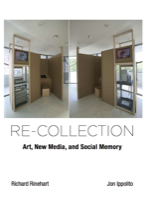
 We published the first academic book on digital preservation
Now in paperback: the MIT Press textbook for our DIG 550 class published by one of our faculty members, hailed as "a bold and inspiring manifesto on how best to care for the art and culture of the digital age."





Do you manage digital files in an archive, museum, library, lab, studio, business, or government office? This innovative distance learning program could be for you. Our students learn how to collect, make accessible via database and Web site, and preserve digitized and born-digital assets, from VHS tapes and JPEGs to Word documents and genomic data.
Fall 2026 featured courses
Summer 2026 courses are full, but registration is open for our fall courses, which run from 31 August to 11 December. Seats are available in both courses, and no prerequisites are required. Apply now to reserve your spot.
DIG 500 Introduction to Digital Curation
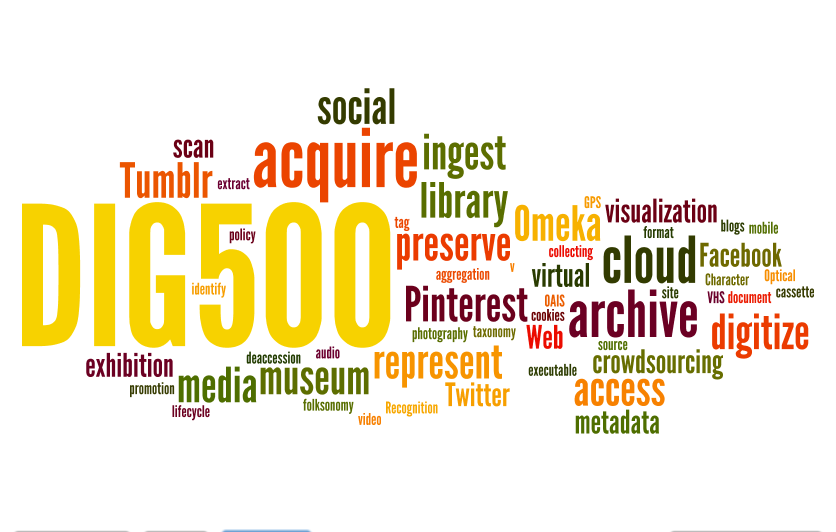 Returning this fall is our introductory class in the sequence, which surveys the full course of the curatorial workflow, from acquisition to preservation. More...
DIG 540 Digital Collections and Exhibitions
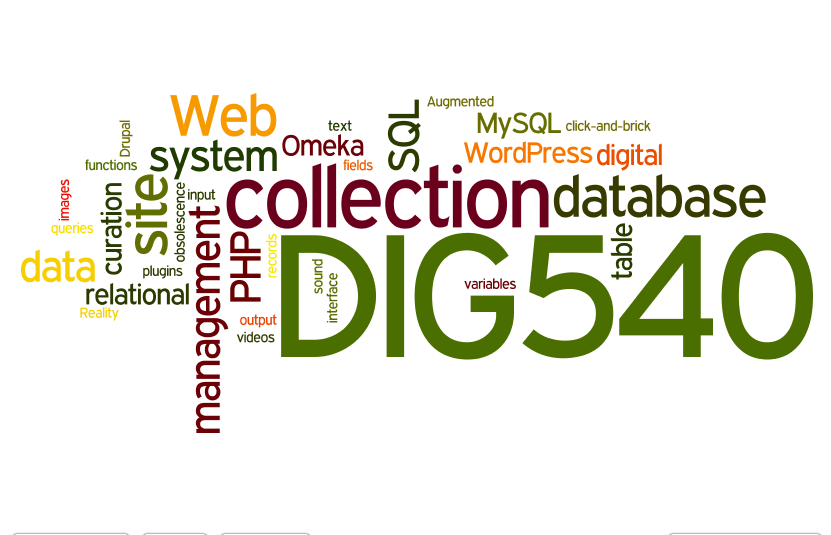 Learn how to store your collection in a database and put that collection online this fall using PHP and MySQL. More...
No prerequisites are required for any course. For syllabi and more details, click on Courses at left.
Free digital curation webinars
New! How Green Is Your Prompt?
A non-partisan, fact-based examination of AI's environmental impact with an emphasis on common archival practices. Learn more .
Honey, AI Shrunk the Archive
Digital Curation professor Jon Ippolito explains how generative AI could rewrite the world's cultural heritage. .
Combining human and artificial intelligence in today's archives
Sara and Ben Brumfield share groundbreaking experiments on integrating AI and crowdsourcing into curatorial workflows. .
Digital Curation into the Shadow of AI
This teleconference features Whitney curator and digital trailblazer Christiane Paul on AI's impact on art. .
Digital permanence and Web3 with Glen Weyl
Could a radically re-imagined Internet ensure trust between strangers? Find out from one of the architects of a successor to our current Internet. .
Digital evidence with Shelley Lightburn
Digital Curation alumna and International Court of Justice archivist Shelley Lightburn met with us about the challenges and opportunities that digital evidence presents to the judicial process. .
Archiving the Internet with Jason Scott
The Internet Archive's Jason Scott spoke with us about saving digital culture with novel techniques like emulation and crowdsourcing. .
Watch interactive recordings of these and other webinars.
Learn generative AI with us
Thanks to a new partnership with Learning With AI, we're educating students on the impact of text- and image-generators like ChatGPT on their workplaces, including an entire module dedicated to generative AI in our introductory course.
Interested? Check out our recent presentations on how and when to use generative AI.
Fast-track curriculum
Students now have the option of completing the certificate in as little as nine months. Learn more.
Who needs digital curation?
- An archivist in a photographer's studio wants to put a database of vintage sailing photos online but doesn't know where to start.
- A librarian is acquiring hundreds of born-digital files but doesn't know which of the dozens of metadata schemes to apply to this collection.
- A town official is feeling pressure to keep digital records but isn't sure what formats will be accessible in the long term.
- A researcher in a lab is gathering data but unsure how to share her findings with the world or safeguard them for the long term.
- A curator in a museum dedicated to Native traditions is worried that her recordings of indigenous stories will be lost once the audio cassettes are no longer playable, and she's unsure how to catalogue them or migrate them to new formats.
 There is a growing need in many areas of the public and private sector for better understanding of and training in the selection, preservation, maintenance, and archiving of digital resources.
Our students work at both public institutions and private companies—from august bodies such as the Library of Congress and the International Court of Justice at The Hague to smaller organizations such as national parks and videogame startups.
The University of Maine's Digital Curation certificate provides a critical skill-set for employees and employers that prepares them to address pressing data and material management issues while positioning them and their business or institution for the future.
Program Curriculum
The Digital Curation curriculum offers students the opportunity to complete a 4-6 course (12-18 credit) program of study leading to a certificate, or to choose individual courses most relevant to their interests and career. Depending upon timing, it's possible to complete the certificate in only 9 months.
The curriculum's conceptual trajectory traces the stages that a curator typically follows when caring for an artifact: 1) acquiring it; 2) representing it with metadata; 3) making it accessible via a database-driven Web site; and 4) preserving it in the long term.
1. Acquisition
Related themes: digitization, recording, selection, law
DIG 500: Introduction to Digital Curation
DIG 500 is both an introduction to essential concepts in the field and a practicum in the first phase of the curation workflow, namely the acquisition of digital files. The class surveys the variety of digital artifacts that we consciously or unconsciously create and consume today, with a focus on how to collect and manage digitized and born-digital artifacts and their related data. Students learn technical skills such as how to digitize analog documents, photographs, videos, and 3d objects, as well as curatorial knowledge such as how selection criteria vary as a function of type of institution (archives v. libraries v. museums) and field (art v. archeology). The course also reviews methods for ensuring the ongoing integrity of the artifact and laws governing the acquisition and use of intellectual property, such as how copyright extends to images, editions, and future versions of a work. 3 credits. No prerequisites. Syllabus
Next offered in the fall semester
2. Representation
Related themes: documentation, metadata
 DIG 510: Metadata
This course surveys current standards for describing and encoding artifacts in terms that aid their future discovery or preservation. The class covers digital formats for describing the contents and contexts of artifacts with an emphasis on their use in libraries, archives, and online repositories. The syllabus includes both particular metadata standards such as Dublin Core and OAI as well as their expression in different markup languages such as HTML, XML, and RDF. 3 credits. No prerequisites; DIG 500 recommended. Syllabus
Next offered in late spring/summer
3. Access
Related themes: database, collection, presentation, network
DIG 540 Digital Collections and Exhibitions
This course covers the technical means and social consequences of assembling and sharing cultural data and artifacts. Topics can include the fundamentals of relational databases ; a survey of collection management packages, both proprietary and open-source ; case studies of Web-based collection portals--their successes and failures ; and specific languages (PHP and MySQL) and platforms for hosting collections online. No prerequisites; DIG 510 recommended. More on this course. Syllabus
Next offered in the fall semester
Qualified students may substitute these advanced courses in database management:
SIE 507: Information Systems Software Engineering / COS 480: Database Management Systems
4. Preservation
Related themes: obsolescence, conservation, media formats
 DIG 550: Digital Preservation
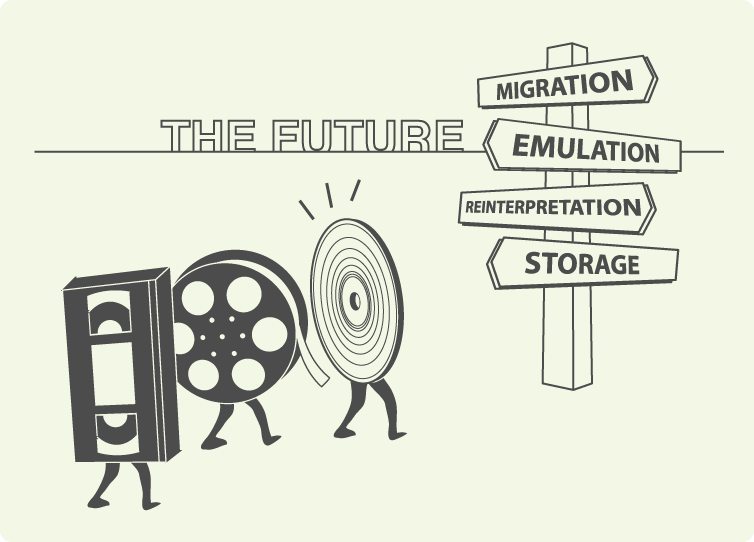
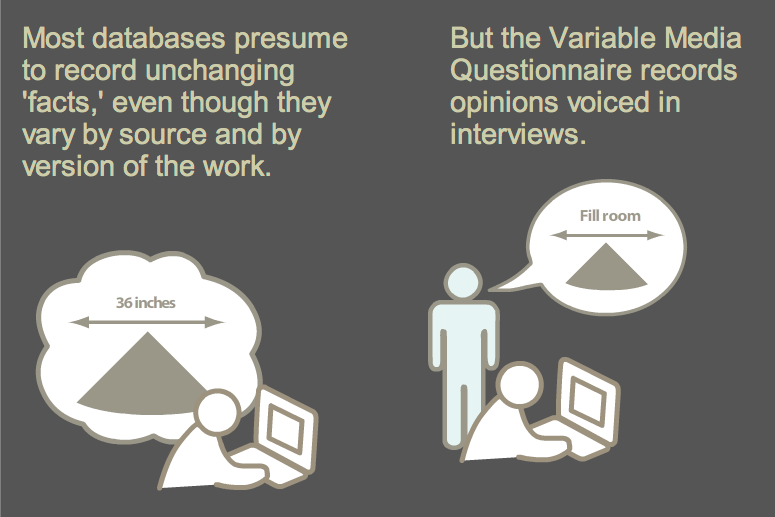
This course acquaints students with the challenges of, and best practices for, preserving digital artifacts. Topics can include a survey of the (sometimes bewildering) array of formats for digital media, along with their vulnerabilities and half-lives ; analysis of various preservation strategies (storage, migration, emulation, reinterpretation) ; institutional, legal, and practical impediments to preservation ; preservation standards and resources for digital media (Media Matters, Variable Media Questionnaire). No prerequisites; DIG 540 recommended. Syllabus
Next offered in the spring semester
5. Internship (optional)
DIG 580: Digital Curation Internship (optional)
Related themes: fieldwork, placement, community
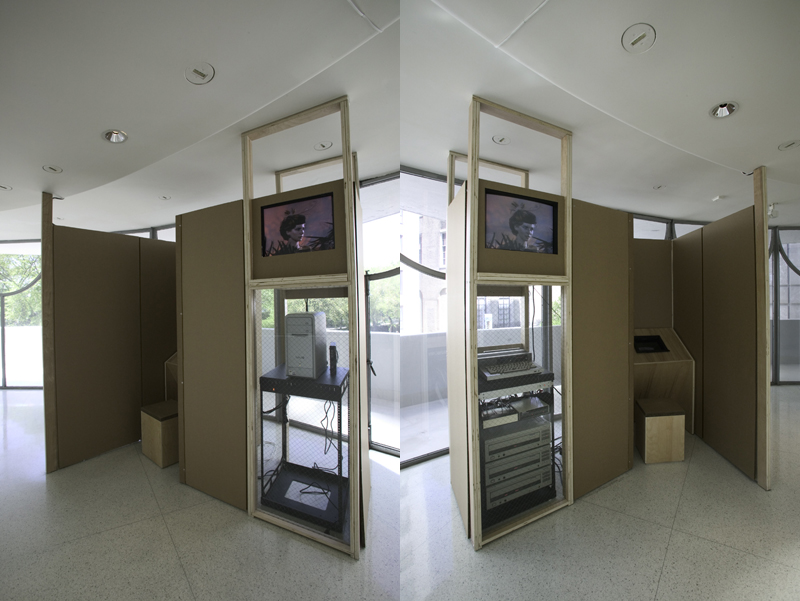 This course offers students the opportunity to work directly with an institution in the field to research and implement a solution for one or more of the stages of digital curation. A dedicated instructor may supervise a period of directed reading (say, on metadata schemes) followed by fieldwork (say, cataloguing a collection), or be available for consultation about a particular project in the workplace (such as an effort to digitize photographs or overhaul a website).
As of fall 2017, the internship is optional. Students who want to complete the program as quickly as possible may forego the internship, while students who want help applying course concepts to the workplace can opt to pay from one to three credit hours for faculty to monitor their progress and help them troubleshoot and evaluate the experience.
Students can also choose from numerous courses already on the books depending on their interests and the opportunities available:
MSE 497: Independent Study in Museum Studies/Museum Education
Advanced independent study or research and writing projects in Museum Studies, Museum Education or related areas. May be repeated for credit. Prerequisites & ; Notes: MSE 200 or permission of instructor. 1-3 credits
SIE 590: Information Systems Internship
Utilization of knowledge gained from the information systems graduate program within a business, non-profit or government organization and acquisition of practical training. See also some of the internship opportunities provided by collaborating businesses and agencies in Maine. Prerequisites & ; Notes: Successful completion of nine credits of required courses in the MSIS program. 3-6 credits
NMD 597: Independent Study in New Media
Graduate level study and research in New Media or related areas directed by a graduate faculty member in New Media. Prerequisites & ; Notes: Graduate Standing and permission. 3 credits
HTY 597: Field Work in Historical Institutions
Field work in local museums, state agencies, and other historic laboratories. Involves preparation and repair of exhibits, research and preparation of historic preservation documents, and beginning archival and artifact handling. Prerequisites & ; Notes: graduate students, senior history majors and others by permission. 3 credits.
 6. Elective (optional)
As of fall 2017, DIG students may choose to complete an additional elective but it is not required for the fast track to the certificate. The University of Maine offers numerous online courses that can qualify; here are examples of special interest to digital curation students:
COS 430: Introduction to Cybersecurity
An overview of Cybersecurity as information security, policies, guidelines, and legal issues ; the nature of network and computer attacks, system vulnerabilities and defense ; implementation issues in Unix/Linux. Projects include system setup, attack, and defense. Prerequisites & ; Notes: COS 335 and COS 431. 3 credits.
EDT 545 Information Security in the Education Environment
Covers privacy and security in the educational environment from several perspectives: legal issues, social and ethical concerns, standards and policy development. Prerequisite EDT 520, or permission of instructor.
EDT 520 Digital Age Teaching and Learning Methods
In this foundational course students will explore how digital tools allow for new models of teaching and learning. Students will engage in a critical review of how technology has been used, and explore current trends in educational settings. Students will discuss relevant theories of cognition, explore issues of access and equity, and consider how curriculum, instruction, and assessment might be designed with the support of technology. The learning environment for the course will model different engagement, instructional, and assessment strategies including readings, multiple modes of discussion and reflection, practical applications, design projects, and social networks.
EDT 550 Video Communications in the 21st Century
Examines roles of video in education and the technology behind video as an information medium. Prerequisite EDT 520, or permission of instructor.
EDT 598 Technology Supported Inquiry-Based Teaching and Learning
This course examines the role of technology in active, inquiry-based teaching and learning environments. Participants will explore self-directed questions and problems engaging in inquiry-based instructional methods supported by technology resources and tools. An integral component of this course will be the development of an inquiry-based facilitation plan that fosters and promotes active student questioning, critical thinking, and complex problem solving for implementation in classroom environments. Emphasis is placed on student-centeredness, constructivist learning theories, and problem based teaching and learning approaches.
EDT 560 Applying Technology to Assessment in Education
Students will first explore the traditional vocabulary used for assessment and learning. Students will then evaluate, discuss, reflect upon, and consider the implications of integrating technology and digital assessment tools in the pK12 classroom to support knowledge acquisition and creation of new knowledge. Students will look through a variety of lenses for students understanding and assessment including ISTE, SAMR, and Bloom’s among others.
EDT 598 Designing Networks to Optimize Learning
When designing networks for schools it is important for technology leaders to understand the why, in order to inform the how. Emphasis will be placed on the function of spaces to maximize utility and optimize learning. Students will learn network design approaches that allow for flexibility and growth. Students will explore networking concepts through the lens of a school renovation or construction project. Starting with a single proof of concept classroom, students will expand their infrastructure design to connected learning spaces, and ultimately tie their solution together as a school wide network.
EDT 598 Advanced Instructional Design
Advanced Instructional Design continues EDT 540 Instructional Design and Project Management and extends students’ knowledge of the theory and practice of instructional design as well as introduces students to the practice of research in instructional design. Students will design original 2D and 3D models of physical spaces as well as plan types of instruction and learning that their designs would facilitate. Students will also work with technology mediated approaches to instruction and plan curricula that helps students master content and skills appropriate for the 21st Century information culture. Throughout, students will critically assess the efficacy of their own and each other’s designs to meet learning objectives. Prerequisite EDT 540, or permission of instructor.
INT 400: Pop! Tech: The Impact of Technology on Society
A unique, interdisciplinary, online experience designed around the annual Pop! Tech Conference in Camden, Maine. Explores the impact of technology on society, environment, governance, ethics, and other aspects of our personal, professional, and civic lives—both for our world today and the future we have a hand in shaping. Prerequisites & ; Notes: Junior standing or permission. 3 credits.
SIE 515: Human Computer Interaction
Students are introduced to the fundamental theories and concepts of human-computer interaction (HCI). Topics covered include: interface design and evaluation, usability and universal design, multimodal interfaces (touch, gesture, natural language), virtual reality, and spatial displays. Prerequisites & ; Notes: SIE or MSIS graduate student or permission of instructor. 3 credits.
SIE 525: Information Systems Law
Current and emerging status of computer law in electronic environments: rights of privacy, freedom of information, confidentiality, work product protection, copyright, security, legal liability ; impact of law on use of databases and spatial datasets ; legal options for dealing with conflicts and adaptations of law over time. Prerequisites & ; Notes: Graduate standing or instructor permission. 3 credits.
SIE 550: Design of Information Systems
Theoretical foundation for the representation of knowledge in information systems and logic-based programming as a tool for fast prototyping. Object-oriented modeling and database schema design for engineering applications. Database management systems and their suitability for engineering data, transaction concepts and query languages, including SQL. Prerequisites & ; Notes: Graduate standing or permission of instructor. Targeted at students with strong technical background. 3 credits.
SIE 558: Real-time Sensor Data Streams
A hands-on introduction to relational databases, including Arduino programming, data stream processing and tools for big data. Targeted at students with some technical background. 3 credits.
Register
You can register for a single class or as part of the Graduate Certificate just by following the instructions in this easy online application.
The application for the entire Certificate requires little more than a 3-5 paragraph statement describing the digital curation challenges you have encountered in your past or future life/work, and how you think our program might help you overcome those challenges.
Certificate applicants will also need to request a transcript from your undergraduate or graduate school. Though many of our students will have a Masters degree, only a BA is required.
Tuition
Tuition for in-state students is about $600 per credit hour, or roughly $1800 per class; please check the associated UMaine Online page for the latest figures. Tuition for out-of-state or international students is normally higher, but the Digital Curation program offers such students a discount to 125% of the in-state rate for those accepted to the certificate. Few textbooks are required for our courses. As of 2022 there are no additional fees for individual courses or the program beyond this.
Although the certificate is designed to be completed in two years, industrious students can complete the certificate in nine months, while part-time students may choose to spread the 12-15 credits (4-5 courses) over a longer period, or take a course individually as needed.
To make things easier for students currently working in collecting institutions, the final course is an internship that may take place in the student's own workplace. Also, for teachers and librarians, school districts sometimes offer salary incentives for credits accumulated above the BA or MA.
Questions?
Please email program director Jon Ippolito at ude.eniam@otiloppij to learn more!
Faculty
The following UMaine faculty members teach in the Digital Curation program:
 John Bell, Assistant Professor of Digital Curation, UMaine/Director, Data Experiences and Visualizations Studio, Dartmouth
- Kendra Bird, Adjunct Faculty, School of Computing and Information Science / Faculty of Computer Technology, Eastern Maine Community College
 Desiree Butterfield-Nagy, Archivist, Cohen Collection, Fogler Library
- Craig Dietrich, Co-creator of Scalar and Mukurtu, Senior Research Fellow at Still Water lab
 Richard Hollinger, Head, Special Collections, Fogler Library
  Paul Smitherman, Special Collections Specialist, Fogler Library
  Jon Ippolito, Professor, New Media program
 Pauleena MacDougall, former director, Maine Folklife Center
 Justin Wolff, Professor, Department of Art
Consulting faculty include:
- Gretchen Faulkner, Director, Hudson Museum
- Richard Judd, Professor, Department of History
- Curtis Meadow, Adjunct, Department of Computer Sciences
- Silvia Nittel, Associate Professor, Department of Spatial Information Science and Engineering
- Harlan Onsrud, Professor, Department of Spatial Information Science and Engineering
Praise for our program
Mystified by metadata? Perplexed by preservation? The University of Maine's Digital Curation program has you covered, at least to judge from these reviews from student evaluations:
- "The instructors are approachable, personable, and collegial with students."
- "Well-ordered sequence, and an abundance of reading and informal exchange without an overemphasis on scholarly responses."
- "Being able to read from Re-collection: New Media and Social Memory, while given lessons by one of the book's authors...that's just fantastic!"
- "The breadth of [the instructors'] experience and knowledge (to say nothing of the eloquence, informativeness, and wit of their text) have made me feel that this [program is] a national standard for the study of digital curation."
And here are testimonials from recent graduates working everywhere from the Harvard Archives to the U.S. Naval Undersea Museum:
Through the four courses as part of the Digital Curation Certificate program, I was able to assess the conceptual and practical sides of digital preservation and curation. From thinking about file types and data capture to increased opportunities for object sharing, the program held me captivated and pushed my thoughts on our collection. I was able to tie each course back to my job responsibilities, utilizing our collection for each final project, but each course also pushed forward my thinking on ongoing work projects. The conversations I had with my classmates over Slack were thorough and thought-provoking, and I appreciated the varied backgrounds we each brought to the course. At the end of this program, I feel far more prepared to tackle digital acquisitions at our institution!— Beth S.
The program is structured in a logical, efficient way that delivers a comprehensive look at the world of digital objects. I gained knowledge of the dilemmas and possibilities of digital collections, and how to sensibly build and preserve them. "DIG" faculty are thoughtful and responsive. They cultivate a positive, inclusive environment, and understand the time constraints that busy adults face. I also really appreciate that my classmates come from such a wide variety of professional fields. In a world moving away from paper records—and remote work becoming a new normal—digital curation is more important than ever.— Sean C.
As someone tasked with managing digital records and an archive at my place of work, it quickly became clear that what I’d learned for my MLS 15 years ago needed updating. The Digital Curation certificate program has been everything I needed—it has pushed me intellectually and philosophically, allowed me to use my actual workplace as a source for class projects, and given me a group of peers struggling with similar issues. The need for skills in this area is dire, and I’ve been very impressed with the combination of theory and practice shared by our professors. Classes have been easily fit into my busy life as a full-time professional, parent, and community volunteer....I will walk away with a broad understanding of the basic issues confronting records managers and archivists and plenty of experience getting under the hood with real-world projects. Plus, I really enjoyed myself and my classmates!— Anne S.
In researching programs, I was most drawn to UMaine's because the author of one of the seminal works in the field directs the program. I weighed UMaine, John's Hopkins, and Harvard's Extension program before ultimately settling on UMaine and their friendly pricing structure for Online, Out of State Tuition. Once in the program, I was struck by the collegiality of the faculty and the very high standards for learning in the program. I feel this program has demanded much of me and has helped me expand my professional knowledge in unexpected ways.— Donna R.
I was very happy with the internship experience and enjoyed working with Desiree and Paul. I felt that I was able to apply many of the things I learned in my classes: thinking about what is being curated and what voices and perspectives are (or are not) being shared, trying out and reporting on different software, choosing the appropriate metadata, and recording and communicating the results in a clear and cogent manner. It was a very satisfying conclusion to the digital curation program!— Anna A.
More...
Digital Curation teleconferences
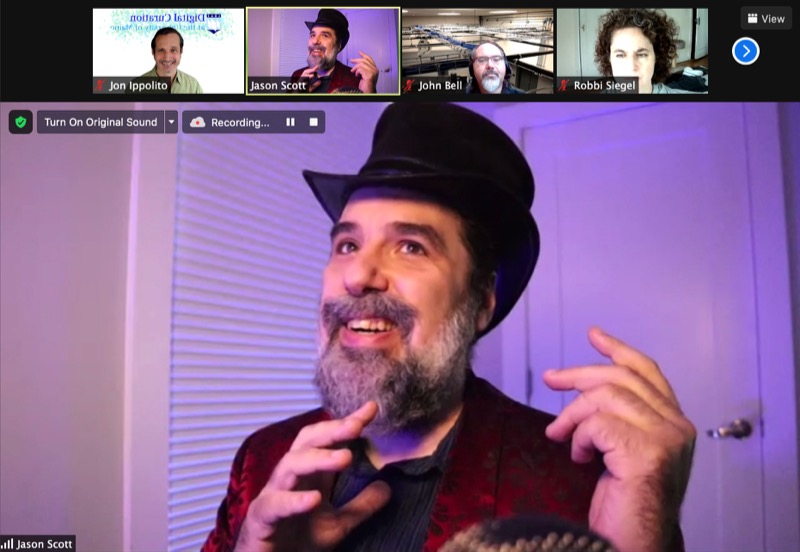 The Digital Curation graduate program organizes periodic webinars that are free to the public. Students are encouraged to pose questions to participants about real-world applications of the knowledge they learn in our classes.
Past webinars have featured leaders at organizations working at the cutting edge of digital heritage and data, including the Library of Congress, Internet Archive, International Court of Justice, Rhizome, and Whitney and MoMA museums.
Archived recordings of these events can be accessed through an interactive table of contents. See the entire list.
Frequently Asked Questions
What is digital curation?
Digital curation means keeping track of the digital materials--text, photos, music, movies, data--you collect in your home and workplace. In the digital era, this maintenance requires skills, strategies, and policies that are different than how traditional offices, libraries, labs, and archives are managed.
Is the Digital Curation program right for me?
Our program is a graduate certificate, taught online, intended for folks working in museums, archives, labs, artist studios, government offices, and anywhere that people need to manage digital files. The program walks students through the phases of managing digitized or born-digital artifacts, including acquisition, representation, access, and preservation.
How might someone use digital curation in the workplace?
Say you're a photo archivist. These courses would answer questions like how to scan analog photos into a database, how to add metadata to make them searchable online, and how to cope with the rapid obsolescence of the software and hardware used to catalogue them.
What class should I take first?
Our introductory course, DIG 500 (Introduction to Digital Curation), is offered in September. This first course covers how digital artifacts are made, acquired into collections, and tracked, including legal and technical considerations. But you can take courses out of sequence if that's easier for you.
How do I apply?
Follow the instructions under the Register option.
Do I have to take the full certificate?
Although the certificate is designed to be completed in two years, industrious students can complete the certificate in nine months, while part-time students may choose to spread the 12-18 credits (4-6 courses) over a longer period. And you can cherry-pick any individual courses that appeal to you.
My workplace needs curation badly. How quickly can I apply what I learn in this program?
You're in luck. To make things easier for students currently working in collecting institutions, we have designed the internship so it may take place in the student's own workplace.
Are there any scholarships or financial aid?
University classes normally cost three times more for out-of-state or international students than for in-state ones--but for the Digital Curation graduate certificate, we offer a big tuition discount that comes out to only 25% more than the in-state price.
Even if this isn't enough, we have tried to make the program as affordable as possible. For example, as one way to encourage outside sponsorship, we have designed an optional course as an internship that may take place in the student's own workplace. Our hope was that a collecting institution might cover part or all of the tuition, since it would benefit from both the student's added expertise and the actual work done for the internship.
As an added incentive, our understanding is that many school districts offer salary incentives for credits accumulated above the BA or MA in programs like ours.
How much work does a course require?
Budget something like 2-5 hours of reading / viewing / assignments per week, though that depends entirely on the instructors.
Do I ever need to come to your campus?
Our program doesn't require you to come to our campus at any time--though we'd be delighted to meet you. As an online curriculum, there are no required synchronous times. In other words, there are deadlines by which you should have done the readings, contributed to online discussions, or posted assignments--but otherwise you can do it all on your own time.
That said, we try to schedule some synchronous times when everyone can video- or text-chat using Zoom or a similar free program, though these are optional. And of course we'd be delighted to meet you on the Orono campus anytime!
Do I have to take courses in sequence?
The courses in the Digital Curation program are designed to flow from beginning to end. That said, we do our best to make each syllabus accessible to first-time students. That means you don't need any prerequisites to take any course.
How can I keep up with news about the program?
You can also follow us on Twitter as @DigitCurator, or contact us with specific questions or to be put on our email newsletter.
For more information
For more information, please contact Kimberly Lai at +1 661 544-8675 or ude.eniam@ial.ylrebmik.